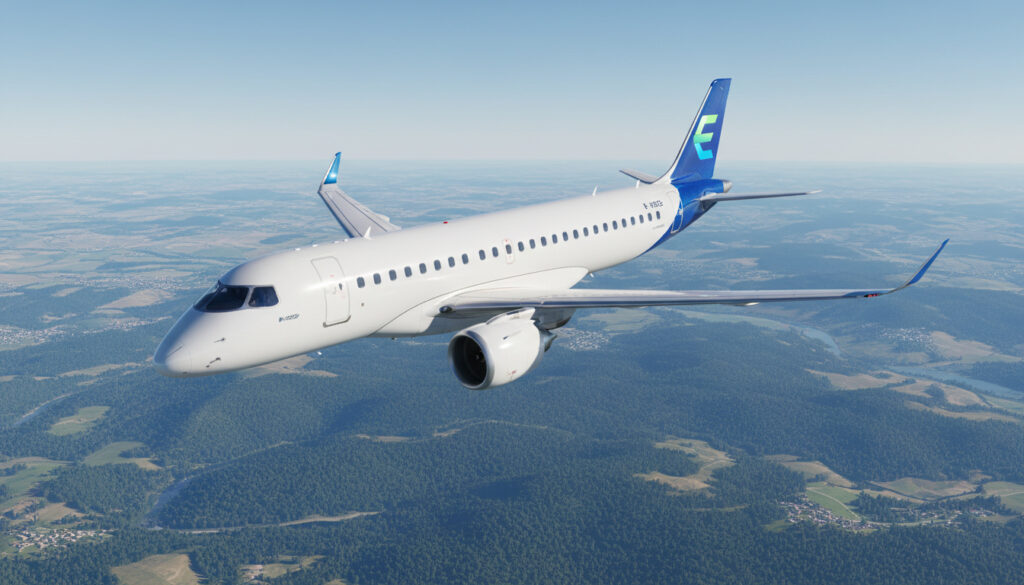
Embraer E195-E2 – Specifications Range Capacity Guide
The Embraer E195-E2 represents the upper limit of regional jet capability, stretching the definition of narrow-body efficiency into territory traditionally held by mainline aircraft. As the largest member of the Brazilian manufacturer’s E-Jets E2 family, this twin-engine platform combines expanded passenger capacity with transcontinental range figures that challenge conventional fleet segmentation.
Launched as part of a comprehensive generational update to the successful E-Jet series, the E195-E2 entered service amid shifting market demands for fuel-conscious, high-density regional operations. Its design targets operators seeking to replace aging narrow-bodies or expand route networks without the operational complexity of larger single-aisle aircraft.
What is the Embraer E195-E2?
- 25% improvement in fuel burn over first-generation E195
- Certified by ANAC, FAA, and EASA in 2018–2019
- First delivery to Porter Airlines in 2022
- Maximum cruise speed of Mach 0.82
- Service ceiling of 41,000 feet
- Maximum takeoff weight upgraded to 62,500 kg in 2024
- Part of a three-variant E2 family covering 76–146 seats
| Specification | Value | Notes |
|---|---|---|
| Overall Length | 41.5 m | 136.2 ft |
| Wingspan | 35.1 m | 115.2 ft |
| Height | 10.8 m | 35.4 ft |
| MTOW | 62,500 kg | 2024 upgrade |
| Maximum Payload | 16,150 kg | 35,605 lb |
| Max Usable Fuel | 13,690 kg | 30,159 lb |
| Typical Seating | 132 seats | Single class |
| Maximum Seating | 146 seats | 28-inch pitch |
E-Jets E2 family overview
The E195-E2 occupies the top tier of the E-Jet E2 family, which includes the smaller E190-E2 and the E175-E2. Together, these variants cover maximum takeoff weights ranging from 44.6 to 62.5 tonnes and operational ranges between 2,000 and 3,000 nautical miles. Embraer designed the family to provide incremental capacity steps while maintaining commonality in engines and flight deck architecture.
What are the key specifications of the Embraer E195-E2?
Passenger capacity and configuration
Maximum seating density reaches 146 passengers when arranged at a 28-inch pitch, though most operators select intermediate configurations. A three-class layout accommodates 120 travelers with graduated legroom: 12 seats at 36-inch pitch, 24 at 34 inches, and 84 at 31 inches. KLM’s technical documentation notes flexibility for up to 136 passengers in mixed configurations.
Airlines may select from three distinct interior layouts. The three-class arrangement provides 120 seats with premium pitch, while the single-class dense configuration accommodates 146 passengers at 28-inch spacing. Porter Airlines operates a 132-seat variant arranged in a 2×2 layout across 33 rows, eliminating middle seats entirely.
Range and performance
Range capabilities expanded significantly through the 2024 performance upgrade, extending maximum reach to 3,000 nautical miles from an initial 2,519 nm. Operational data indicates a maximum cruise speed of Mach 0.82, equivalent to 876 km/h, while the service ceiling stands at 41,000 feet. Takeoff field length at maximum weight requires 1,615 to 1,915 meters under standard conditions, and landing distance at maximum landing weight spans 1,215 to 1,290 meters.
What powers the E195-E2 and how efficient is it?
Engines and fuel burn
Two Pratt & Whitney PW1900G turbofans provide propulsion, delivering thrust between 85 and 102 kilonewtons depending on specific sub-variant and operational requirements. Technical specifications confirm these geared turbofans contribute to a 25% reduction in fuel consumption compared to the original E195 generation.
Embraer delivered a certified performance upgrade package in 2024 that increased maximum takeoff weight to 62,500 kilograms while extending range to 3,000 nautical miles. These modifications also reduced specific fuel consumption by an additional 2.5 percent compared to baseline E2 specifications.
How does the E195-E2 compare to competitors and who operates it?
Vs Airbus A220
The E195-E2 competes directly with the Airbus A220 in the 120- to 150-seat narrow-body segment. While both aircraft offer comparable range envelopes, the Embraer variant emphasizes higher-density regional configurations and specific fuel burn per seat advantages over older regional jets. Direct head-to-head operational cost analyses remain proprietary to individual airlines and lessors.
Market positioning
Against the Windsor Homes for Sale – MLS Prices, Neighborhoods & 2026 Outlook segment, the aircraft positions as a high-capacity regional solution rather than a mainline narrow-body. It offers superior per-seat efficiency compared to smaller regional jets like the Bombardier CRJ900 while avoiding the crew and operational costs associated with larger narrow-bodies.
Major operators
Porter Airlines represents the most visible operator, having accepted delivery of aircraft from a confirmed order of 50 units between 2022 and 2023. The airline configures its fleet with 132 seats in a two-by-two arrangement. KLM also operates the type, though specific delivery quantities and configuration details remain partially undisclosed in public filings.
Order and delivery status
Embraer reports strong demand across the E2 family, but disaggregated order books specific to the E195-E2 variant remain unpublished. The manufacturer’s aggregate backlog includes firm commitments from multiple undisclosed customers, with Porter Airlines representing the only publicly confirmed fleet operator of significant scale.
Direct performance comparisons with the Airbus A220 rely primarily on manufacturer marketing materials rather than independent head-to-head analysis. While the E195-E2 demonstrates advantages in specific fuel consumption per seat over older regional jets, verified third-party benchmarks against the A220 remain unavailable in public sources.
What is the development timeline of the E195-E2?
- : Embraer formally announces the E-Jets E2 family development program, positioning the E195-E2 as the largest variant. Source: Wikipedia
- : ANAC grants type certification; FAA and EASA approvals follow shortly after. Source: Embraer
- : Entry into service with initial deliveries to launch customers. Source: Technical Documentation
- : Porter Airlines accepts delivery of confirmed aircraft on order. Source: Porter Airlines
- : Performance upgrade package certified, extending range to 3,000 nm and increasing MTOW. Source: AeroExpo
What remains certain and uncertain about E195-E2 capabilities?
| Established Specifications | Uncertain or Pending Information |
|---|---|
| Physical dimensions certified at 41.5m length and 35.1m wingspan per Embraer technical documentation | Exact order backlog figures specific to the E195-E2 variant remain undisclosed; only family-level aggregates are reported |
| Fuel efficiency gains of 25% over first-generation E195 verified through flight testing | Long-term maintenance cost projections and engine durability data beyond initial service years remain unverified |
| Porter Airlines configuration of 132 seats confirmed in active service | Direct operational cost comparisons with Airbus A220 await independent airline operational data releases |
How does the E195-E2 fit into the regional aviation market?
The aircraft occupies a specific niche bridging high-capacity regional operations and thin mainline routes. Its dimensional constraints allow access to airports with infrastructure limitations that exclude larger narrow-bodies, while its 3,000-nautical-mile range enables stage lengths previously requiring larger equipment. Windsor Homes for Sale – 2025 Prices and Buyer Guide analyses suggest similar segmentation strategies apply in asset-heavy markets where fleet flexibility determines route viability.
Embraer’s marketing emphasizes the type’s role in replacing first-generation regional jets and early narrow-bodies nearing retirement. The 25% fuel efficiency improvement over the E195 addresses sustainability pressures while the 2×2 cabin configuration eliminates middle seats—a passenger experience advantage against larger single-aisle alternatives in competitive markets.
What sources verify E195-E2 performance claims?
The E195-E2 offers 25% better fuel efficiency than the original E195, with a 2024 upgrade improving fuel burn by 2.5% and enabling the range boost to 3,000 nm.
Dimensions of approximately 41.5–41.6 m length, 35.1–35.12 m wingspan, and 10.8–10.9 m height.
What defines the Embraer E195-E2?
The Embraer E195-E2 stands as the largest variant of the E-Jets E2 family, combining 132-to-146-seat capacity with 3,000-nautical-mile range and 25% fuel efficiency gains over its predecessor. Powered by Pratt & Whitney PW1900G engines and operated prominently by Porter Airlines, the aircraft bridges regional and mainline operations through certified performance upgrades and narrow-body operational economics.
Frequently asked questions
What is the maximum takeoff weight of the E195-E2?
The maximum takeoff weight (MTOW) was upgraded to 62,500 kilograms (137,788 lb) in 2024, an increase from the initial 61,500 kg certification.
What is the service ceiling of the E195-E2?
The aircraft is certified to a service ceiling of 41,000 feet (12,497 meters).
What are the exact physical dimensions?
The E195-E2 measures 41.5 meters in length, 35.1 meters in wingspan, and 10.8 meters in height.
What is the maximum landing weight?
Maximum landing weight (MLW) is certified at 54,000 kilograms.
How many rows does Porter Airlines use?
Porter Airlines configures its E195-E2 fleet with 132 seats arranged across 33 rows in a 2×2 layout.
What is the maximum fuel capacity?
The maximum usable fuel capacity is 13,690 kilograms (30,159 lb).
More related posts
 Leeds United vs Liverpool: H2H Stats, Results & Prediction
 Morgan Freeman: Diagnosis, Age, Wife, Net Worth & Updates
 Anne Dorval: Biography, Age, Movies, Net Worth & More
 Prince William: Life, Family, Royal Role, and FAQs
 David Allan Coe: Conviction, Elvis Song, Net Worth, and Death
 Ten Foot Henry Calgary Menu: Prices, Hours & Parking
 Nostradamus Predictions for 2025: Top Quatrains and Interpretations
 CAD to MXN: Canadian Dollar to Mexican Peso Rate
