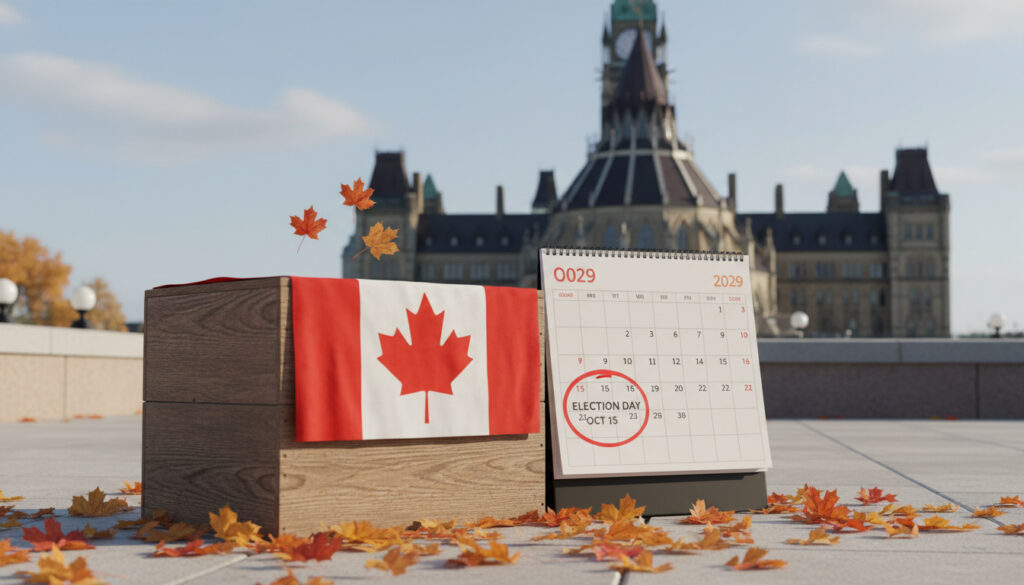
When Is Election Day in Canada – 2029 Date and Key Rules
Canadian federal elections follow a statutory framework that sets a fixed date every four years on the third Monday in October. While this system creates predictable scheduling, constitutional powers allow for flexibility that can shift timelines significantly.
The most recent federal election occurred on , following an early election call that superseded the fixed date originally anticipated for October 2025. This event illustrates the interplay between legislated schedules and the discretionary authority held by the Prime Minister.
Understanding the mechanics of these dates requires examining statutory requirements, constitutional constraints, and the administrative rules governing the electoral process.
When Is the Next Federal Election in Canada?
The Canada Elections Act mandates that federal elections occur on the third Monday in October in the fourth calendar year following the previous election. Based on the April 2026 election, the next statutory fixed date would fall in October 2029.
Key facts about the scheduling system include:
- Fixed dates occur every four years on the third Monday in October.
- The system was established in 2007 to create electoral predictability.
- Prime Ministers maintain constitutional authority to advise early dissolution.
- Election campaigns must last between 36 and 51 days after the writ is issued.
- The Constitution imposes an absolute maximum of five years between elections.
- Minority governments may trigger early elections through non-confidence motions.
- Elections Canada may recommend alternate dates for religious or cultural reasons.
| Fact | Details | Legal Basis |
|---|---|---|
| Statutory Fixed Date | Third Monday in October | Canada Elections Act |
| 2025 Fixed Date | October 20, 2025 | Fixed-date legislation |
| 2026 Election Date | April 28, 2026 (36-day campaign) | Election records |
| Cycle Length | Every 4 years | Parliamentary convention |
| Writ Period | 36-51 days after issuance | Electoral law |
| Constitutional Limit | Maximum 5 years | Constitution Act, 1867 |
| Voting Eligibility | Canadian citizens | Citizenship guidelines |
| Provincial Variations | Most provinces have fixed dates | Provincial legislation |
Can the Election Date in Canada Be Changed?
Fixed-date legislation does not eliminate the Prime Minister’s power to request dissolution. The Canada Elections Act explicitly states that nothing in the fixed-date section affects the powers of the Governor General, including the power to dissolve Parliament at the Governor General’s discretion.
The Mechanism of Early Elections
When a Prime Minister advises an early election, the writ of election must be issued, and polling day must occur no sooner than 36 days and no later than 51 days afterward. The 2026 election utilized the minimum 36-day period.
Early elections may also arise procedurally. If a minority government loses the confidence of the House of Commons through a non-confidence motion, an election typically follows.
Despite fixed-date laws, the Prime Minister retains the legal authority to advise the Governor General to dissolve Parliament at any time, triggering an election that supersedes the statutory schedule.
Constitutional Boundaries
The Constitution Act, 1867, and the Canadian Charter of Rights and Freedoms establish an absolute requirement that no more than five years pass between elections. Parliament cannot override this five-year limit, even through the Charter’s notwithstanding clause.
When Was the Last Federal Election and What Is the Cycle?
The April 28, 2026 election followed a sequence of political events that disrupted the anticipated October 2025 fixed date. This pattern reflects how Canada’s electoral calendar can compress or extend based on parliamentary circumstances.
The 2021 Baseline
The previous general election occurred on . Under the four-year fixed-date cycle, the next scheduled election should have occurred on October 20, 2025.
The 2026 Disruption
Prime Minister Justin Trudeau announced his resignation on . Mark Carney subsequently won the Liberal Party leadership on March 9, 2026. Rather than convene Parliament and face a potential non-confidence vote, Carney requested dissolution, leading to the April 28 polling date.
What Are the Key Logistics for Election Day?
Election Day mechanics involve standardized timing, advance voting provisions, and accommodation for special circumstances. Elections Canada administers these processes with authority to adjust schedules when necessary.
Standard Polling Hours
Polls typically open for twelve hours on Election Day, though exact times vary by time zone to ensure uniformity across the country. Voters must cast ballots at their assigned polling stations based on residential address.
Advance Voting Options
Advance polls operate for four days, usually Friday through Monday, the week before Election Day. These polls allow voters who anticipate scheduling conflicts on the main polling day to participate without special arrangement.
Advance polls typically open on the Friday, Saturday, Sunday, and Monday preceding Election Day, providing flexibility for voters with work or travel conflicts.
Alternate Date Procedures
The Chief Electoral Officer possesses discretionary authority to recommend an alternate polling day if the scheduled date conflicts with a day of cultural or religious significance or with provincial or municipal elections. Such recommendations must be made by August 1 of the election year, with alternate dates limited to the next day or the following Monday.
Voters must prove identity and address. Acceptable options include a single government-issued photo ID with address, or two pieces of ID with at least one showing the address.
What Is the Timeline for Calling a Federal Election?
- : Federal election held, resulting in a minority government.
- : Statutory fixed date under the four-year cycle.
- : Prime Minister Trudeau announces resignation.
- : Mark Carney wins Liberal Party leadership contest.
- : Parliament scheduled to return from prorogation.
- : Snap election held, 36 days after the writ was issued.
What Is Definite About Canada’s Election Schedule?
| Established Facts | Uncertain Elements |
|---|---|
| Maximum five-year parliamentary term mandated by Constitution | Exact timing of early election calls by minority governments |
| Fixed date occurs every four years on the third Monday in October | Specific advance poll dates until the writ is formally issued |
| 36-day minimum campaign period after writ issuance | Potential for non-confidence motions in minority parliaments |
| Elections Canada authority over poll administration | Whether alternate dates will be needed for cultural conflicts |
Why Did Canada Adopt Fixed Election Dates?
Parliament enacted fixed-date legislation in 2007 to eliminate the strategic advantage held by governing parties in choosing favorable moments for elections. The reform aimed to “level the playing field for all parties” by removing the uncertainty that previously surrounded election timing.
However, constitutional conventions regarding the Crown’s prerogative to dissolve Parliament were preserved. This creates a hybrid system where dates are predictable unless political circumstances trigger early dissolution.
Provincial jurisdictions have largely followed the federal model, though recent reversals in Nova Scotia (March 2025) and Ontario (November 2025) demonstrate that fixed-date regimes remain subject to legislative modification.
What Do Official Sources Confirm About Election Dates?
Elections Canada maintains the definitive record of electoral dates and administrative rules. The agency confirms that while statutory dates provide the framework, the legal authority for dissolution rests with the Governor General acting on ministerial advice.
Elections Canada has discretionary authority to recommend an alternate polling day if the Chief Electoral Officer believes the scheduled date conflicts with a day of cultural or religious significance or with a provincial or municipal election.
Elections Canada, Administrative Guidelines
How Can Voters Prepare for the Next Election?
Eligible voters should verify their registration status through Elections Canada’s online services, confirm polling station locations, and understand identification requirements well before the writ is issued. Those considering relocation to major electoral battlegrounds, including border regions, may research local real estate markets through resources like Windsor Homes for Sale – MLS Prices, Neighborhoods & 2026 Outlook or review historical pricing data via Windsor Homes for Sale – 2025 Prices and Buyer Guide.
Frequently Asked Questions
How often are federal elections held in Canada?
Federal elections occur every four years on fixed dates, though early elections can be called. The Constitution mandates a maximum five-year interval between elections.
What time do polls open on Election Day?
Polling hours vary by time zone to ensure uniformity across the country, typically spanning twelve hours. Specific times are announced by Elections Canada for each electoral district.
Where can I find official Election Day information?
Elections Canada operates the official elections.ca website, which provides verified dates, polling locations, and eligibility requirements.
Can the election date move for religious holidays?
Yes. The Chief Electoral Officer may recommend alternate dates if the scheduled day conflicts with religious or cultural observances, provided the recommendation comes by August 1 of the election year.
What is the shortest possible election campaign?
The Canada Elections Act mandates a minimum 36-day campaign period between the issuance of the writ and Election Day.
More related posts
 How Long Does Nicotine Stay in Your System: Detection Guide
 Riu Palace Punta Cana: Reviews, Comparison & Booking Guide
 La Roche-Posay Effaclar Duo – Guide to Versions, Benefits and Use
 Recipes with Basic Ingredients: Fridge & Pantry Guide
 How to Reduce Inflammation in the Body – Evidence-Based Strategies
 A Good Girl’s Guide to Murder: Plot, Cast, Season 2 & Parents Guide
 How Old Is Ovechkin – Age, Birthday, NHL Facts 2025
 What to Eat Before Working Out: Timing & Best Foods
