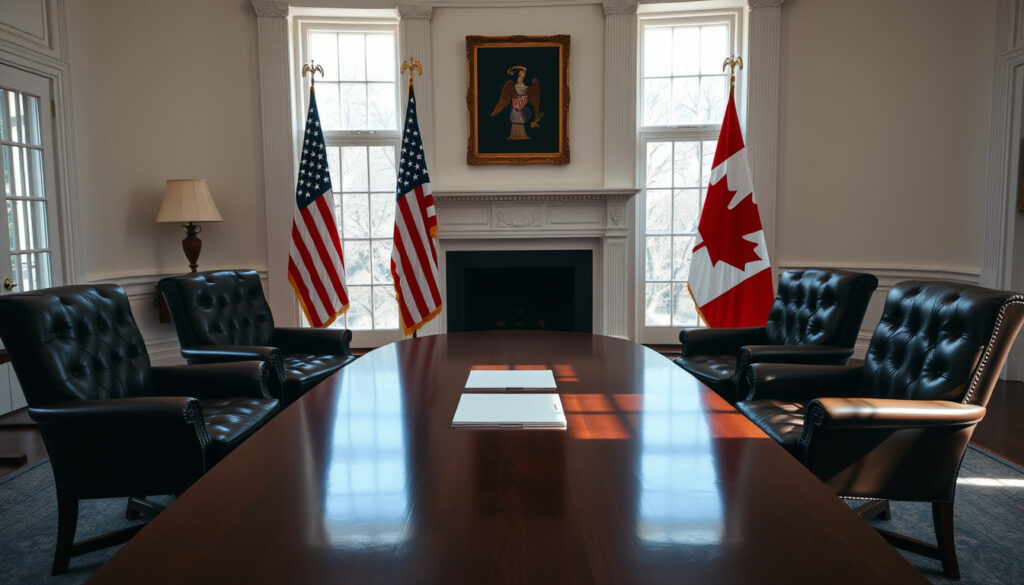
Carney and Trump Meeting: What Happened at the White House
When two leaders meet for the first time, the official readouts often tell only part of the story — as was the case on October 7, 2025, when Prime Minister Mark Carney sat down with President Donald Trump in the Oval Office for a working lunch amid escalating trade tensions and political uncertainty in Canada. What emerged was a mix of diplomatic warmth, pointed disagreement, and homework assignments for cabinet ministers on both sides.
Meeting Date: October 7, 2025 ·
Location: White House, Oval Office ·
Key Topic: US-Canada trade and border security ·
Participants: President Donald Trump, Prime Minister Mark Carney
Quick snapshot
- Meeting took place October 7, 2025, in the Oval Office (Prime Minister of Canada)
- Leaders discussed trade, border security, and defence (The White House)
- Meeting set for 2026 CUSMA renegotiation (CBC News)
- Teams tasked to find deals on steel, aluminum, and energy (POLITICO)
Here’s a quick reference of the key meeting facts.
| Fact | Detail |
|---|---|
| Date | October 7, 2025 |
| Location | Oval Office, White House |
| Duration | Working lunch (exact time not specified) |
| Public statements | Trump called trade a ‘natural conflict’; Carney rejected 51st state idea |
Has Carney ever met Trump?
Details of the October 7 Meeting
- The bilateral meeting on October 7, 2025, was the first known face-to-face encounter between Mark Carney and Donald Trump (Prime Minister of Canada (official release)).
- It took place in the Oval Office and was classified as a working lunch (The White House (official video archive)).
- Cabinet-level officials from both governments attended the meeting (POLITICO (Washington political news outlet)).
Previous interactions between Carney and Trump
- Before becoming prime minister, Carney served as Governor of the Bank of Canada and later the Bank of England; no known direct meetings with Trump have been recorded in that period (CBC News (Canadian public broadcaster)).
Bottom line: Carney and Trump held their first in-person meeting on October 7, 2025, but it was a working trip, not a summit, with no formal agreement signed.
How has Carney responded to Trump?
Carney’s public statements on trade and sovereignty
- Carney described the meeting as focused on building a new economic and security relationship (Prime Minister of Canada (official readout)).
- He publicly rejected the idea of Canada becoming a 51st state, a remark Trump had made in the past (Global National (Canadian evening news broadcast)).
- Carney called the talks “constructive” but did not claim a finalized agreement (Reuters (international wire service)).
Reaction to Trump’s 51st state remark
- Carney responded by explaining Canada would not react to every comment, but made clear the country’s sovereignty was not negotiable (Global National (Canadian evening news broadcast)).
Ottawa’s messaging of ‘material progress’ contrasts with the lack of concrete tariff relief — a gap that will define the next phase of negotiations.
The implication: Canada’s public posture of progress may not match the private reality of continued trade friction.
Did Carney promise a deal with Trump?
Specific commitments made during the meeting
- No confirmed deal was promised. Canadian officials indicated ahead of the meeting that they were not expecting major announcements (Global National (Canadian evening news broadcast)).
- The Prime Minister’s Office said the leaders directed their teams to conclude work on steel, aluminum, and energy in the coming weeks (Prime Minister of Canada (official release)).
- POLITICO reported that Canada-U.S. Trade Minister Dominic LeBlanc said both sides aimed to quickly arrive at a deal (POLITICO).
Outcome of trade discussions
- After the meeting, Global News reported there were no breakthroughs and no tariff relief (Global National).
- CBC reported that the leaders left without announcing relief on steel, aluminum, or softwood lumber tariffs (CBC News (Canadian public broadcaster)).
- Reuters noted that Trump said he would be open to a deal on tariff reductions but did not commit to immediate relief (Reuters).
Bottom line: No deal was signed; Carney and Trump agreed to continue talks, with a focus on sector-specific agreements before the 2026 CUSMA renegotiation.
Does Carney get along with Trump?
Public demeanor during joint appearance
- Trump described the relationship as involving a “natural conflict” on trade (Reuters).
- Carney referred to the talks as constructive, avoiding personal animosity (Prime Minister of Canada).
Underlying tensions on trade and border
- POLITICO reported that Howard Lutnick warned Canada should expect concessions in the auto sector if it wanted a deal (POLITICO).
- CBC noted that the Canadian side treated the meeting as part of the larger 2026 renegotiation of CUSMA (CBC News).
Despite the cordial public tone, Trump’s description of “natural conflict” and Lutnick’s tough line on auto concessions signal continued friction beneath the surface.
The pattern: public warmth masks deep disagreements that will resurface in sectoral talks.
| Issue | Trump’s stance | Carney’s stance |
|---|---|---|
| Trade tariffs | Open to reductions but no immediate relief (Reuters) | Sought sectoral agreements; no deal reached (PMO) |
| Border security | Emphasized need for cooperation | Agreed to further talks |
| 51st state remark | Made the remark earlier | Rejected; sovereignty non-negotiable (Global National) |
Can Canada survive without U.S. trade?
Current trade dependence
- The Prime Minister’s Office noted that 85% of Canada-U.S. trade was tariff-free at that time (Prime Minister of Canada).
- The meeting also covered defence and Arctic security, indicating broader strategic alignment beyond just trade (Prime Minister of Canada).
Alternatives and diversification strategies
- Carney met U.S. senators Jim Risch, Jeanne Shaheen, and Mike Crapo, suggesting outreach to Congress (Prime Minister of Canada).
Bottom line: Canada’s trade reliance on the U.S. remains high, but Carney and Trump used the meeting as a foundation for ongoing negotiations rather than a decisive turning point.
Timeline of Carney-Trump interactions
- Pre-2025: Mark Carney serves as Governor of Bank of Canada, then Bank of England; no known direct meetings with Trump (CBC News).
- October 7, 2025: First official meeting with President Trump at White House (Prime Minister of Canada).
- Post-meeting: Media coverage highlights trade disagreements and body language analysis (CBC News).
The pattern: interactions were sparse before 2025, and the October meeting set the stage for a more confrontational relationship.
What’s known and what’s not
Confirmed facts
- Meeting took place on October 7, 2025, in Oval Office (Prime Minister of Canada).
- Trump and Carney discussed trade and border issues (The White House).
- Carney publicly rejected the idea of Canada becoming a 51st state (Global National).
What’s unclear
- Whether any formal deal was reached (CBC News).
- Long-term impact on US-Canada trade relations (Reuters).
- Private details of working lunch discussions (POLITICO).
The catch: confirmed facts are largely procedural; the real impact remains uncertain.
Key quotes from the meeting
We have a natural conflict on trade.
President Donald Trump, as reported by Reuters
Canada won’t react to every comment, but our sovereignty is non-negotiable.
Prime Minister Mark Carney, via Global National
What this means: The two leaders framed the relationship in starkly different terms—Trump as conflict, Carney as principle.
What this meeting ultimately produced was a framework for further talks — not a breakthrough, but the beginning of a process. For Canadian businesses and policymakers, the implication is clear: prepare for sector-by-sector negotiations, with no guarantee of near-term tariff relief, or risk falling behind in the 2026 CUSMA renegotiation.
Related reading: Canadian shoppers protest US products · Toronto Stock Market Today
The meeting at the White House was the latest chapter in the Carney-Trump trade negotiations that have defined their relationship.
Frequently asked questions
What was the purpose of the Carney-Trump meeting?
The meeting aimed to address US-Canada trade tensions, border security, and defence cooperation ahead of the 2026 CUSMA renegotiation.
Did Carney and Trump agree on any trade policies?
No formal agreement was reached. They directed officials to work on deals for steel, aluminum, and energy.
How did the US media cover the Carney-Trump meeting?
Coverage emphasized the lack of tariff relief and the “natural conflict” comment from Trump.
What is Mark Carney’s background before becoming prime minister?
Carney served as Governor of the Bank of Canada and later the Bank of England. He became prime minister in March 2025.
Will there be follow-up meetings between Carney and Trump?
Both sides have indicated ongoing discussions, with cabinet-level teams continuing to work on sector-specific deals.
More related posts
 What to Eat Before Working Out: Timing & Best Foods
 Prince Edward: Biography, Role, and Royal Namesakes
 Richest Man in the World 2025: Who Holds the Title
 Pep Guardiola: Wife, Health, Daughter, and Future Plans
 Water Filter for the House – Best Lab-Tested Picks 2025
 Jobs in Moose Jaw – Full-Time, Part-Time and City Roles
 Marc Anthony: Career, Relationships and Key Facts
 John Wick Franchise: Origins, Films, and the Baba Yaga
