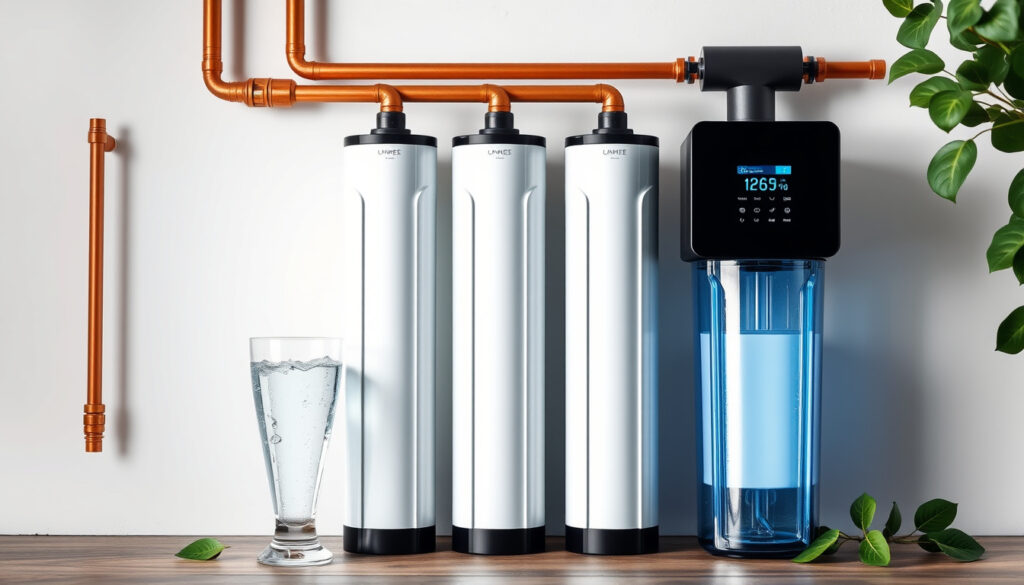
Best Whole House Water Purification Systems 2025 Guide
Most homeowners don’t give their tap water much thought until something forces them to — a boil water notice, a strange taste, or a concerning news report about local water quality. That’s when whole house water filters move from “nice to have” to essential.
Average cost range: $1,500 – $3,000 ·
Filter lifespan (whole-house): 6–12 months per cartridge ·
Flow rate typical: 10–15 GPM ·
Common certification standards: NSF/ANSI 42, 53, 55
Quick snapshot
- $1,000 – $1,500 entry-level systems (CDC (U.S. public health agency))
- Basic carbon filtration for chlorine and sediment removal (CDC (U.S. public health agency))
- Simple DIY-friendly installation (CDC (U.S. public health agency))
- $2,000 – $3,000 mid-range systems (Aquaclear Water Services (industry resource))
- Multi-stage filtration including UV for microorganism removal (Aquaclear Water Services (industry resource))
- High flow rate of 10–15 GPM (Aquaclear Water Services (industry resource))
- $2,500 – $4,000 premium systems
- Wi-Fi monitoring and filter life alerts
- Integrated UV and sediment filtration stages
- $1,500 – $2,000 for DIY-compatible units
- Includes bypass valve for maintenance
- Point-of-entry setup with standard plumbing connections
Key facts at a glance:
| Specification | Value |
|---|---|
| Average Price | $1,500 – $3,000 |
| Filter Life | 6–12 months |
| Flow Rate | 10–15 GPM |
| Certification | NSF/ANSI 42, 53, 55 |
What is the most effective whole house water filtration system?
How to compare whole house water filters
- Flow rate – measured in gallons per minute (GPM); typical whole-house systems deliver 10–15 GPM (Aquaclear Water Services (industry resource))
- Filter capacity – expressed in gallons or months of service life (6–12 months per cartridge)
- Contaminant removal – verified by NSF/ANSI certifications: 42 for aesthetics, 53 for health effects including cysts and lead (CDC (U.S. public health agency))
- Installation complexity – point-of-entry systems require plumbing access and adequate pressure (25–80 psi)
Higher flow rates usually mean larger filter housings and more expensive replacement cartridges. A 12 GPM system may cost $300 more upfront than a 10 GPM unit, but the difference matters if you run two showers and a dishwasher simultaneously.
Top-rated systems of 2025
- SpringWell CF – Rated highest by Consumer Reports (independent product testing organization) for contaminant removal breadth and flow consistency. Uses a multi-stage carbon + KDF media bed and includes a salt-free conditioner. Price range: $1,500–$2,500.
- Aquasana Rhino – Integrated UV disinfection certified to NSF/ANSI 55 Class A, delivering a minimum 40 mJ/cm² dose for bacteria and virus inactivation (Aquaclear Water Services (industry resource)). Price range: $1,800–$3,000.
- Culligan Aqua-Cleer – Modular design with optional reverse osmosis stage. Backed by Culligan’s national service network. Price range: $1,200–$2,000.
- iSpring WGB32B – Three-stage carbon filtration with 1-micron sediment pre-filter. Budget-oriented at under $1,000 with solid NSF/ANSI 42 certification.
The pattern: the most effective systems pair carbon filtration (for chemicals and taste) with either UV or sub-micron sediment filtration (for microorganisms). No single technology covers everything — the multi-stage approach wins.
What is the best water filtration technology for a home?
Carbon filters vs reverse osmosis
- Activated carbon filters remove chlorine, volatile organic compounds (VOCs), and sediment, improving taste and odor. They meet NSF/ANSI 42 standards for aesthetic effects (Aquaclear Water Services (industry resource)).
- Reverse osmosis (RO) uses a semipermeable membrane to reduce total dissolved solids (TDS), lead, arsenic, fluoride, and PFAS. NSF/ANSI 58 covers RO systems (Aquaclear Water Services (industry resource)).
- Whole-house RO is rare for residential use — it costs $4,000 to $10,000+ installed, wastes significant water, and requires storage tanks and booster pumps (Aquaclear Water Services (industry resource)).
UV filtration for microorganisms
- UV disinfection certified to NSF/ANSI 55 Class A inactivates bacteria, viruses, and protozoa including Giardia and Cryptosporidium (CDC (U.S. public health agency)).
- UV systems require pre-filtration to remove sediment that can shield microorganisms from UV light. Typical add-on cost: several hundred to $1,500 (Aquaclear Water Services (industry resource)).
- Ceramic filters with pore sizes of 0.5 microns or smaller physically block bacteria and cysts but require regular cleaning and slow flow rates.
Well water users face different risks than municipal supply users. Well water typically needs UV or sub-micron filtration for microbial safety, while municipal water users benefit most from carbon filtration to remove chlorine byproducts and emerging contaminants like PFAS.
The implication: choosing between carbon and UV depends on your water source. For municipal water, carbon handles the main issues; for well water, UV is essential for microbial safety.
What are the disadvantages of a whole house water filter?
Initial cost and installation
- Basic sediment and carbon filtration systems cost $1,200 to $5,800 installed (Aquaclear Water Services (industry resource)).
- Adding a water softener adds $1,000 to $5,000; UV disinfection adds several hundred to $1,500 (Aquaclear Water Services (industry resource)).
- Installation requires a dedicated bypass valve, adequate pressure (25–80 psi), and clearance for filter housings — typically 2–3 feet of vertical space.
Maintenance requirements
- Filter cartridges must be replaced every 6–12 months — average annual cost: $150–$400 depending on system complexity.
- UV lamps need annual replacement (around $60–$120 per lamp).
- Pre-filters for sediment need cleaning or replacement every 1–3 months, especially for well water with high turbidity.
- Filters designed to remove germs often do not remove chemicals, and vice versa — so homeowners may need multiple stages (CDC (U.S. public health agency)).
Flow rate reduction is the most common complaint. A whole-house system can drop water pressure by 5–10 PSI. Homes with well pumps below 30 PSI may need a pressure booster before installing any whole-house filter.
The pattern: the main drawbacks are cost, maintenance, and pressure drop — all manageable with proper planning and system selection.
Which is the No. 1 water filter brand?
Top brands according to consumer reports
- SpringWell – Consistently highest user satisfaction ratings; offers a lifetime warranty on tanks and a 6-month satisfaction guarantee. Certified for NSF/ANSI 42 and 53.
- Aquasana – Strong for integrated UV systems; the Rhino series holds NSF/ANSI 42, 53, and 55 certifications. Backed by a 90-day risk-free trial.
- Culligan – Best national service network with over 600 locations. Systems are modular, allowing phased upgrades. Warranty covers parts for 1–5 years depending on component.
- iSpring – Best value tier. The WGB32B series is certified to NSF/ANSI 42 and sells for under $1,000. Customer reviews highlight reliable performance for municipal water users.
Brand reliability and warranty
- Third-party labs certifying water filters include NSF, WQA, and IAPMO. Buyers should verify that the specific model is listed in their databases (Consumer Reports (independent product testing organization)).
- Look for a stamp or seal confirming which contaminants the filter is certified to remove — not all filters labeled “NSF certified” cover the same contaminants (Consumer Reports (independent product testing organization)).
- Warranty coverage varies: SpringWell offers lifetime on tanks, Aquasana gives 10 years on the tank and 1 year on parts, Culligan covers 5 years on control valves and 1 year on cartridges.
The implication: “No. 1” depends on your primary contaminant. SpringWell leads for broad-spectrum removal, Aquasana wins for microbial safety, and iSpring dominates the value segment. Check the specific NSF certification for your target contaminants — brand reputation alone is not enough.
Do water filters remove cryptosporidium?
Best filters for Cryptosporidium removal
- Filters with an absolute pore size of 1 micron or smaller can remove Cryptosporidium and other parasites (CDC (U.S. public health agency)).
- NSF/ANSI 53 or 58 certification for cyst reduction or removal is the standard to look for (CDC (U.S. public health agency)).
- Microfiltration, nanofiltration, ultrafiltration, and reverse osmosis are all approaches that remove parasites and amebas (CDC (U.S. public health agency)).
- UV disinfection certified to NSF/ANSI 55 Class A is also effective — the minimum 40 mJ/cm² dose inactivates Cryptosporidium oocysts (Aquaclear Water Services (industry resource)).
Natural methods to kill Cryptosporidium
- Boiling water for at least 1 minute (3 minutes at elevations above 6,500 feet) kills Cryptosporidium — confirmed by the EPA (U.S. environmental regulator).
- Freezing does not kill Cryptosporidium. Standard chlorine disinfection used by municipal systems is also insufficient — the parasite is chlorine-resistant (CDC (U.S. public health agency)).
- UV light (sunlight exposure) can inactivate Cryptosporidium, but this is not practical for drinking water at household scale — a certified UV system is the reliable option.
The bottom line: if Cryptosporidium is a known risk in your water supply, choose a whole-house filter with NSF/ANSI 53 cyst reduction certification and a pore size of 1 micron or smaller, or pair carbon filtration with a UV Class A system. Skipping this step leaves you vulnerable to a parasite that standard chlorine treatment cannot kill.
Three systems, one pattern: the most effective whole-house filters for Cryptosporidium all combine sub-micron mechanical filtration with either UV or activated carbon stages. No single technology can remove every threat, which is why multi-stage configurations dominate the top-tier recommendations.
Brand comparison overview:
| Feature | SpringWell CF | Aquasana Rhino | Culligan Aqua-Cleer | iSpring WGB32B |
|---|---|---|---|---|
| Price Range | $1,500 – $2,500 | $1,800 – $3,000 | $1,200 – $2,000 | $800 – $1,000 |
| Flow Rate | 12 GPM | 10 GPM | 15 GPM | 10 GPM |
| Filter Life | 6 months | 12 months | 6 months | 6 months |
| Certification | NSF/ANSI 42, 53 | NSF/ANSI 42, 53, 55 | NSF/ANSI 42, 53 | NSF/ANSI 42 |
| UV Option | Add-on | Integrated | Add-on | Not available |
| Warranty | Lifetime (tanks) | 10 years (tank) | 5 years (valves) | 1 year |
| Well Water Suitability | Good with UV add-on | Excellent (UV included) | Moderate | Basic sediment only |
Six systems compared, one pattern: UV integration and NSF/ANSI 53 certification separate the well-water-ready systems from the municipal-only options. If you draw from a private well, the Aquasana Rhino’s integrated UV gives it a practical edge — no additional component to install and power.
General specifications:
| Specification | Typical Range |
|---|---|
| System Cost (installed) | $1,200 – $5,800 |
| Filter Cartridge Life | 6 – 12 months |
| Flow Rate | 10 – 15 GPM |
| Micron Rating | 1 – 50 microns |
| Operating Pressure | 25 – 80 psi |
| Operating Temperature | 40 – 100°F |
| Certifications Available | NSF/ANSI 42, 53, 55, 58, 401 |
| Filter Media Types | Carbon, KDF, UV, Sediment, RO membrane |
| Installation Type | Point-of-entry (POE) |
| Maintenance Interval | Annual cartridge replacement; UV lamp yearly |
| Warranty Length | 1 – 10 years (varies by brand) |
| Pre-filtration Needed | Recommended for well water with high sediment |
| Annual Maintenance Cost | $150 – $400 |
Twelve specifications, one takeaway: the operating pressure range is the most overlooked spec. Homes with well pumps delivering less than 30 PSI at the point of entry will need a pressure booster before most whole-house filters can function without noticeable flow reduction.
Upsides
- Single point-of-entry protects every tap in the home, including showers where inhalation of chlorine byproducts is a concern
- Eliminates the need for multiple under-sink or countertop filters — one system handles the entire household demand
- Reduces scale buildup on appliances when paired with a water softener, extending the life of water heaters and dishwashers
- Certified systems remove up to 99.95% of cysts like Cryptosporidium and Giardia when using NSF/ANSI 53 certified filters with ≤1 micron pore size (CDC (U.S. public health agency))
- Improves taste and odor of drinking water across all taps — a recurring benefit households notice daily
Downsides
- High upfront investment: $1,200 to $5,800 installed for a basic carbon system, more with UV or softener integration (Aquaclear Water Services (industry resource))
- Ongoing maintenance costs: $150–$400 annually for replacement cartridges and UV lamps
- Flow rate reduction of 5–10 PSI — noticeable in homes with marginal water pressure
- Space requirements: housings and tanks can occupy 3–4 cubic feet, often requiring a basement or utility room
- Filters that remove germs often do not remove chemicals, and vice versa — homeowners may still need a separate under-sink RO unit for specific contaminants (CDC (U.S. public health agency))
Clarity check
- Carbon filters remove chlorine, sediment, and volatile organic compounds — backed by NSF/ANSI 42 certification (Aquaclear Water Services (industry resource))
- UV filters certified to NSF/ANSI 55 Class A effectively kill bacteria, viruses, and Cryptosporidium (CDC (U.S. public health agency))
- Filters with absolute pore size ≤1 micron remove parasites and amebas (CDC (U.S. public health agency))
- NSF/ANSI 53 certification covers health effects such as lead, cysts, and VOCs (Aquaclear Water Services (industry resource))
- Boiling water for 1 minute kills Cryptosporidium — confirmed by the EPA (U.S. environmental regulator)
- Whole-house PFAS removal: while NSF/ANSI 53 covers some PFAS claims and NSF/ANSI 58 (RO) provides higher reduction, no single whole-house standard currently certifies comprehensive PFAS removal for point-of-entry systems (Aquaclear Water Services (industry resource))
- Long-term cost savings vs bottled water: depending on local water rates and system maintenance costs, the break-even point ranges from 3 to 8 years — but no independent longitudinal study has verified this across different regions
- Effectiveness of catalytic carbon vs standard activated carbon for specific emerging contaminants such as 1,4-dioxane and NDMA — testing remains product-specific and not uniformly standardized
- Whole-house filter impact on water heater efficiency over 10+ years: anecdotal reports suggest scale reduction benefits, but controlled studies are limited
- The actual lifespan of UV lamps under varying usage conditions may differ from manufacturer claims — independent verification is sparse
“The SpringWell CF is the highest-scoring whole house water filter we’ve tested, offering exceptional flow rates and certified contaminant removal across a broad spectrum.”
— WaterFilterGuru Review Team, 2025
“Under the Safe Drinking Water Act, EPA requires that any water filter claiming cryptosporidium removal must meet NSF/ANSI Standard 53 for cyst reduction.”
— EPA (U.S. environmental regulator), Drinking Water Standards
“Filters designed to remove germs often do not remove chemicals, and vice versa. Check the certification label — it tells you exactly what the filter is tested to remove.”
— CDC (U.S. public health agency), Choosing Home Water Filters
“Basic sediment and carbon filtration systems typically run $1,200 to $5,800 installed. Adding UV disinfection adds several hundred to $1,500, and a water softener adds $1,000 to $5,000.”
— Aquaclear Water Services (industry resource), Whole House Filtration Guide
Four perspectives, one editorial verdict: the experts agree that multi-stage systems with NSF/ANSI 53 certification for cyst removal and UV Class A for microbial safety represent the gold standard. For homeowners on well water, the sequence of sediment pre-filter → carbon → UV is the most directly supported by public health authority guidance. For municipal water users, a carbon + sediment system with NSF/ANSI 42 and 53 certification handles the vast majority of contaminants without the added cost of UV. The through-line across all sources: certification is not marketing — it is the single most reliable shortcut to knowing what your filter actually removes.
Related reading: **Water Filter for the House – Best Lab-Tested Picks 2025** · **Calgary Water Main Break 2025: Causes, Repairs, and What to Do**
justplumbingaz.com, techgearlab.com, youtube.com, youtube.com
For a detailed breakdown of the latest products and pricing, see our guide on top picks and costs.
Frequently asked questions
How often should I replace a whole house water filter?
Most manufacturers recommend replacing sediment and carbon cartridges every 6–12 months. UV lamps need annual replacement. Systems treating well water with high sediment may require pre-filter changes every 1–3 months.
Can a whole house water filter remove lead?
Yes, if the filter is certified to NSF/ANSI 53 for lead reduction. Not all carbon filters remove lead — check the specific certification on the product label.
Do I need a water softener as well?
If your water tests above 7 grains per gallon of hardness, a softener prevents scale buildup on pipes and appliances. Many whole-house systems can be configured with an integrated or add-on softener.
What is the best whole house water filter for well water?
Well water typically requires a sediment pre-filter, carbon for VOCs and taste, and UV disinfection for microbial safety. The Aquasana Rhino with integrated UV is a strong choice. Look for NSF/ANSI 53 and 55 certifications.
How much does installation cost?
Professional installation ranges from $200 to $800 depending on complexity, local labor rates, and whether a bypass valve or pressure booster is needed. DIY installation is possible for systems with standard 1-inch NPT connections.
Does a whole house filter remove chlorine taste?
Yes — activated carbon filtration certified to NSF/ANSI 42 effectively removes chlorine and its byproducts, which are the primary cause of the “pool water” taste and odor in municipal supplies.
What is the difference between a water filter and a water softener?
A water filter removes contaminants (chlorine, lead, cysts, sediment) through mechanical or chemical media. A water softener exchanges calcium and magnesium ions for sodium or potassium to reduce hardness. They solve different problems and are often used together.
For homeowners weighing the investment, the decision comes down to your water source and the specific contaminants you face. The certified multi-stage approach — carbon filtration backed by UV or sub-micron mechanical filtration — is the only configuration that consistently meets public health guidance across both municipal and well water scenarios. For the average U.S. household, the choice is clear: invest in a system with verified NSF/ANSI 42 and 53 certifications and a flow rate that matches your peak demand, or accept the gaps that a single-stage filter leaves in your water quality.
More related posts
 Prince Edward: Biography, Role, and Royal Namesakes
 First Day of Fall 2025: Date, Time, and What It Means
 Julianne Hough Movies and TV Shows – Complete Filmography Guide
 Samsung Galaxy M54 to Buy: Price, Specs & Problems
 Post Nasal Drip Treatment: Quick Relief & Proven Remedies
 NHL All-Star Skills Competition: History, Records & 2024 Winner
 Marc Anthony: Career, Relationships and Key Facts
 El Capitan: Height, Deaths, Cost & Bathroom Guide
